Connect to Databricks Unity Catalog
Connect your VeloDB Cloud warehouse to the Iceberg REST endpoint of Databricks Unity Catalog. Configure the Databricks external location, access permissions, and token before creating the SQL catalog.
Prerequisites
- Connect to a VeloDB Cloud warehouse with a SQL user allowed to create catalogs and use the required databases and tables.
- For SaaS and BYOC warehouses, configure network access from the warehouse to both the external catalog endpoint and the storage endpoints returned in table metadata. An endpoint reachable from your laptop may still be unreachable from the warehouse. Contact VeloDB Cloud support when the integration needs private networking or managed runtime configuration.
- Prepare external service permissions for the metadata and data operations you plan to run. Credential vending still requires the external service to grant storage access.
- Replace sample hosts, account IDs, bucket names, and credentials. The HTTP endpoints and development credentials in local service examples are for an isolated test environment. Use HTTPS and restricted credentials for remote access.
Configure Databricks
Create an external location
In Unity Catalog, an External Location is a secure object that associates paths in cloud object storage with Storage Credentials. External Locations support external access, and Unity Catalog can issue short-term credentials to external systems through the Credential Vending feature, allowing external systems to access these paths.
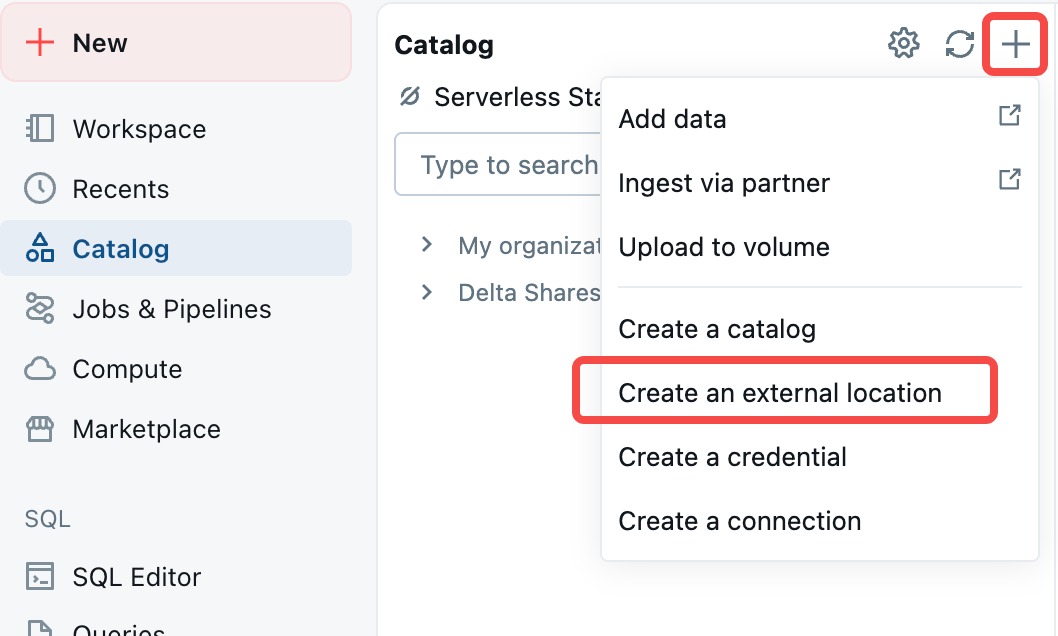
This document uses AWS Quickstart to create an External Location in AWS S3.
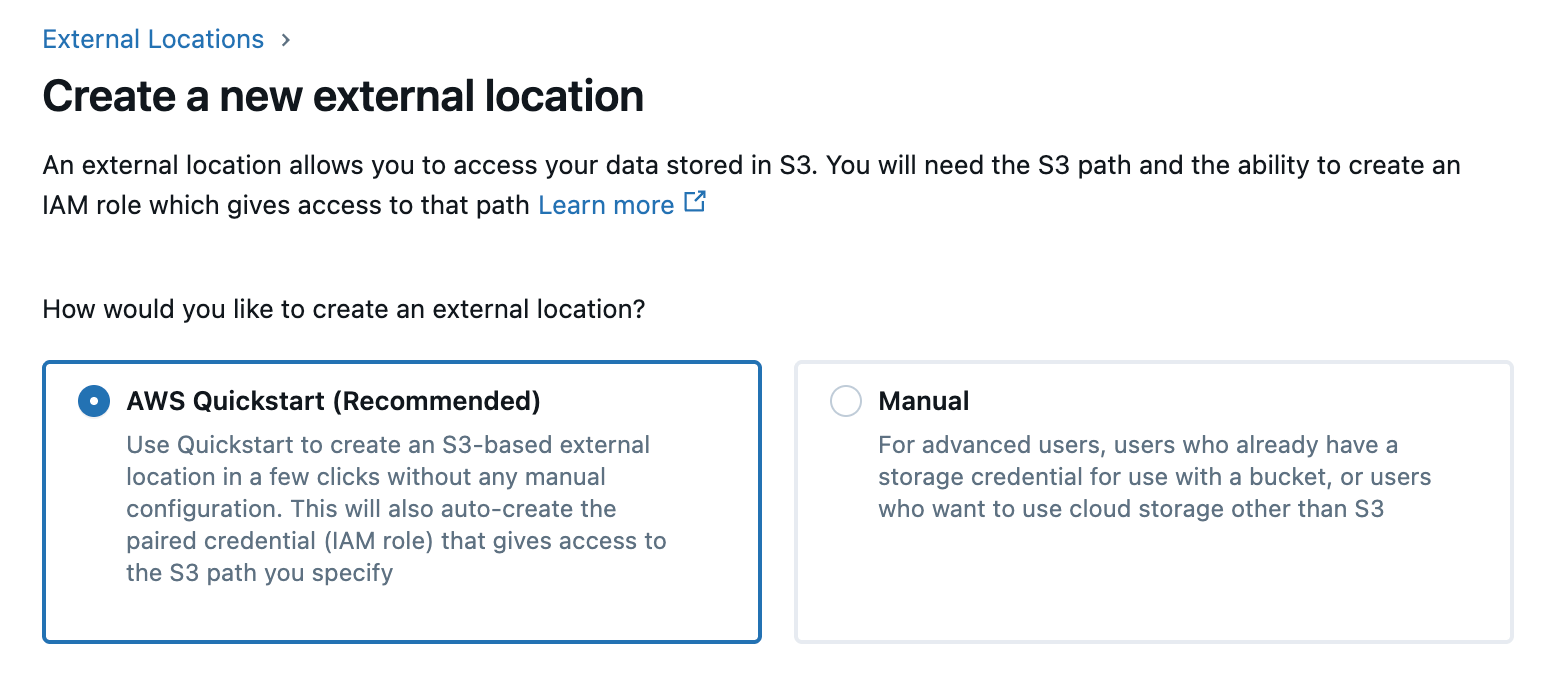
After creation, you can see the External Catalog and its corresponding Credential:
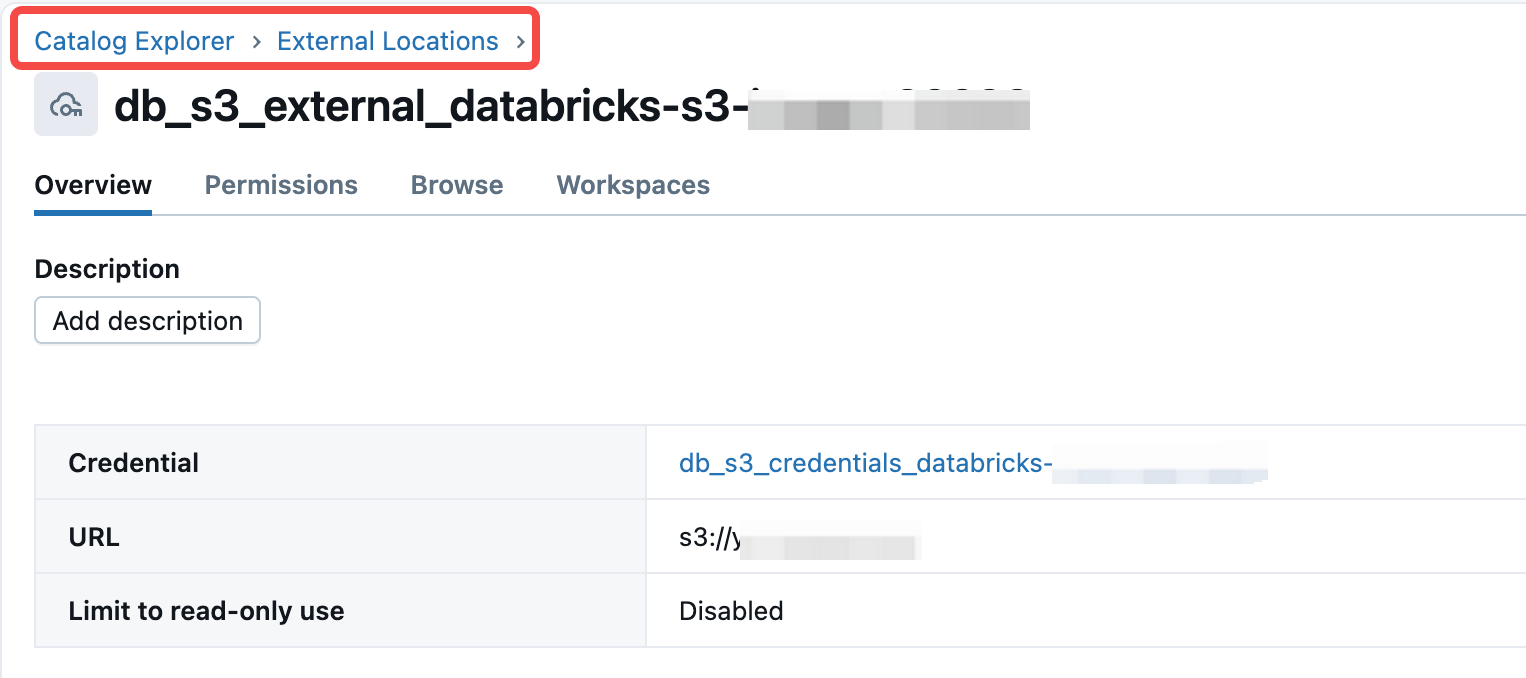
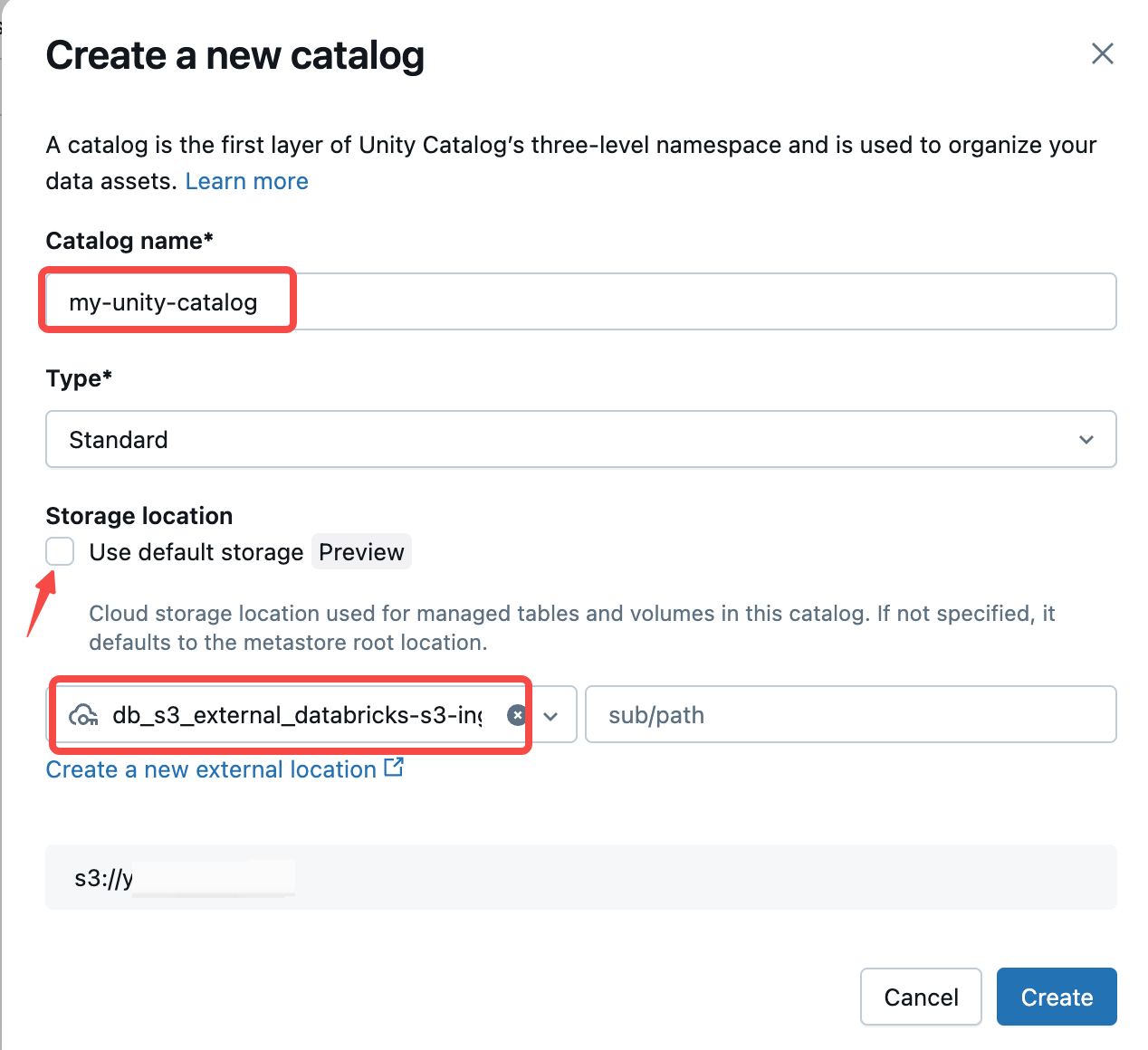
Create a catalog
Click the Create Catalog option in the interface.
Fill in the Catalog name. Uncheck Use default storage and select the External Location created earlier.
Grant external schema permissions
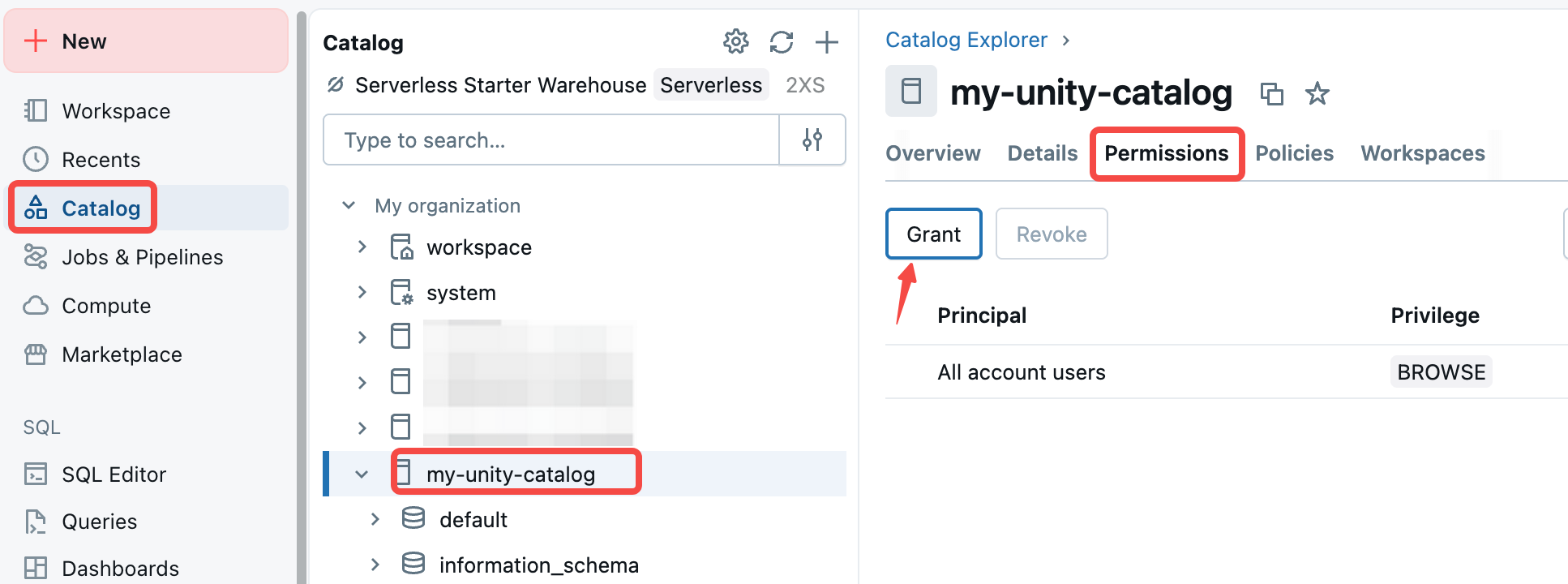
Click on the newly created Catalog → Permissions → Grant:
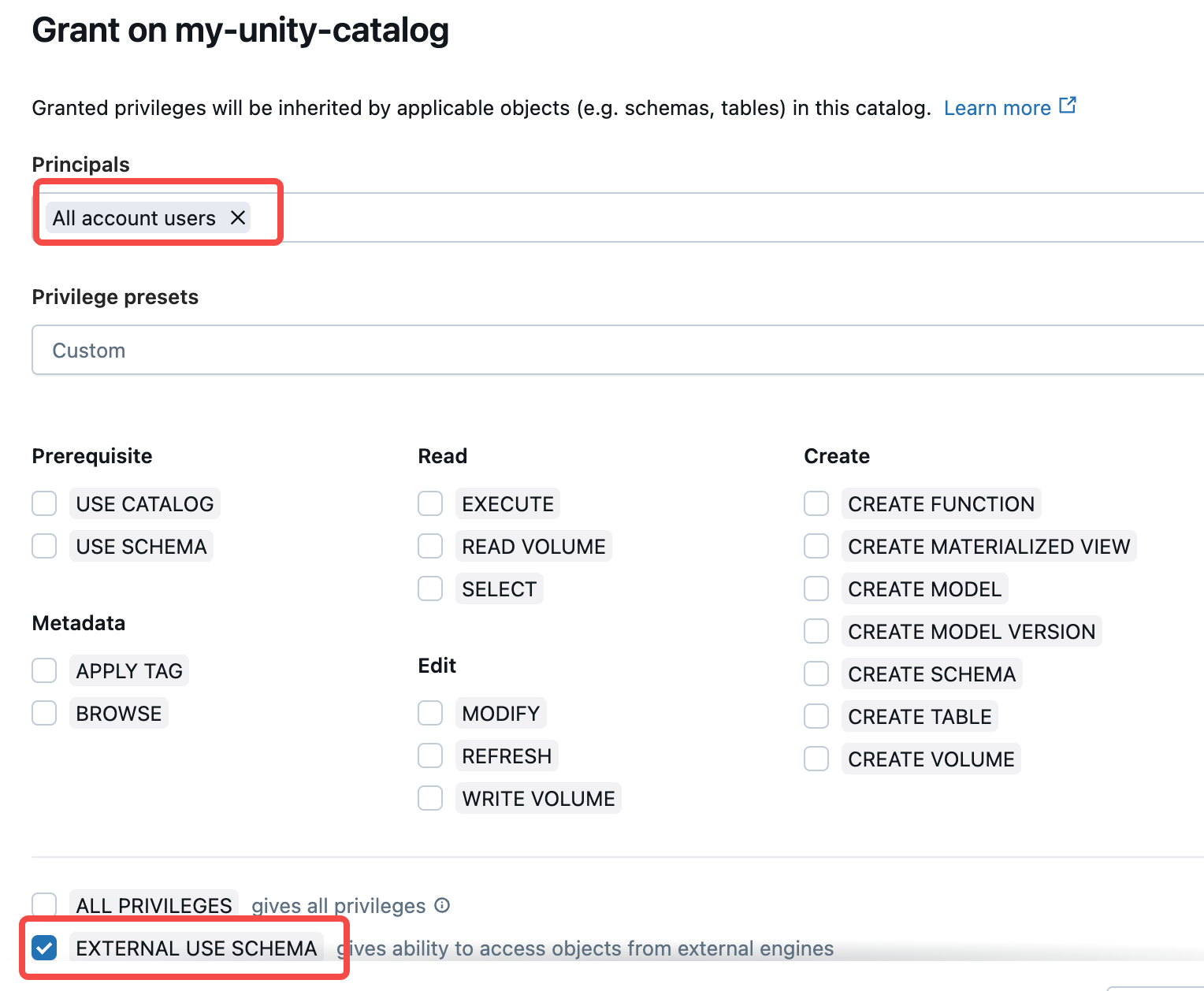
Select All account users and check the EXTERNAL USE SCHEMA option.
Create Iceberg tables and insert data
Execute the following SQL in Databricks SQL Editor to create an Iceberg table and insert data:
CREATE TABLE `my-unity-catalog`.default.iceberg_table (
  id int,
  name string
) USING iceberg;

INSERT INTO `my-unity-catalog`.default.iceberg_table VALUES(1, "jack");
Obtain an access token
Click the user avatar in the top right corner, go to the Settings page, and select Access tokens under User → Developer. Create a new Token for subsequent use when connecting VeloDB Cloud to Unity Catalog. The Token is a string in the format: dapi4f...
Connect the warehouse to Unity Catalog
Create a catalog
-- Use oauth2 credential and vended credentials
CREATE CATALOG dbx_unity_catalog PROPERTIES (
  "uri" = "https://dbc-xx.cloud.databricks.com:443/api/2.1/unity-catalog/iceberg-rest/",
  "type" = "iceberg",
  "warehouse" = "my-unity-catalog",
  "iceberg.catalog.type" = "rest",
  "iceberg.rest.security.type" = "oauth2",
  "iceberg.rest.oauth2.credential" = "clientid:clientsecret",
  "iceberg.rest.oauth2.server-uri" = "https://dbc-xx.cloud.databricks.com:443/oidc/v1/token",
  "iceberg.rest.oauth2.scope" = "all-apis",
  "iceberg.rest.vended-credentials-enabled" = "true"
);

-- Use PAT and vended credentials
CREATE CATALOG dbx_unity_catalog PROPERTIES (
  "uri" = "https://<dbc-account>.cloud.databricks.com/api/2.1/unity-catalog/iceberg-rest/",
  "type" = "iceberg",
  "warehouse" = "my-unity-catalog",
  "iceberg.catalog.type" = "rest",
  "iceberg.rest.security.type" = "oauth2",
  "iceberg.rest.oauth2.token" = "<token>",
  "iceberg.rest.vended-credentials-enabled" = "true"
);

-- Use oauth2 credential and static ak/sk for accessing aws s3
CREATE CATALOG dbx_unity_catalog PROPERTIES (
  "uri" = "https://dbc-xx.cloud.databricks.com:443/api/2.1/unity-catalog/iceberg-rest/",
  "type" = "iceberg",
  "warehouse" = "my-unity-catalog",
  "iceberg.catalog.type" = "rest",
  "iceberg.rest.security.type" = "oauth2",
  "iceberg.rest.oauth2.credential" = "clientid:clientsecret",
  "iceberg.rest.oauth2.server-uri" = "https://dbc-xx.cloud.databricks.com:443/oidc/v1/token",
  "iceberg.rest.oauth2.scope" = "all-apis",
  "s3.endpoint" = "https://s3.<region>.amazonaws.com",
  "s3.access_key" = "<ak>",
  "s3.secret_key" = "<sk>",
  "s3.region" = "<region>"
);
Access the catalog
Once created, you can start accessing Iceberg tables stored in Unity Catalog:
mysql> USE dbx_unity_catalog.`default`;
Database changed

mysql> SELECT * FROM iceberg_table;
+------+------+
| id   | name |
+------+------+
|    1 | jack |
+------+------+
1 row in set (3.32 sec)
Manage Iceberg tables
You can also directly create, manage, and write to Iceberg tables in Unity Catalog through VeloDB Cloud:
-- Write to existing table in Unity Catalog
INSERT INTO iceberg_table VALUES(2, "mary");

-- Create a partitioned table
CREATE TABLE partition_table (
  `ts` DATETIME COMMENT 'ts',
  `col1` BOOLEAN COMMENT 'col1',
  `pt1` STRING COMMENT 'pt1',
  `pt2` STRING COMMENT 'pt2'
)
PARTITION BY LIST (day(ts), pt1, pt2) ();

-- Insert data
INSERT INTO partition_table VALUES("2025-11-12", true, "foo", "bar");

-- View table partition information
SELECT * FROM partition_table$partitions\G
*************************** 1. row ***************************
                    partition: {"ts_day":"2025-11-12", "pt1":"foo", "pt2":"bar"}
                      spec_id: 0
                 record_count: 1
                   file_count: 1
total_data_file_size_in_bytes: 2552
 position_delete_record_count: 0
   position_delete_file_count: 0
 equality_delete_record_count: 0
   equality_delete_file_count: 0
              last_updated_at: 2025-11-18 15:20:45.964000
     last_updated_snapshot_id: 9024874735105617773
See also
Common errors
| Symptom | Check and resolution |
|---|---|
| Connection timeout or hostname resolution failure | Check the catalog URI and connectivity from the warehouse, then check the storage endpoints in table metadata. Ask VeloDB Cloud support to investigate managed network access when needed. |
| Unauthorized or forbidden response | Check the catalog authentication method, token or client credentials, expiry, and permissions on the external catalog and namespace. |
| Catalog metadata loads but a table scan fails | Check storage credentials or credential vending, object permissions, and reachability of the data-file endpoint. Metadata access alone does not grant data access. |
Clean up test resources
Queries and writes consume warehouse compute, and the sample can create billable external storage or services. See Billing Overview. Remove only the test tables and external services you created when you finish. Check the external catalog's deletion behavior before dropping a table or namespace because it can also delete data files.